

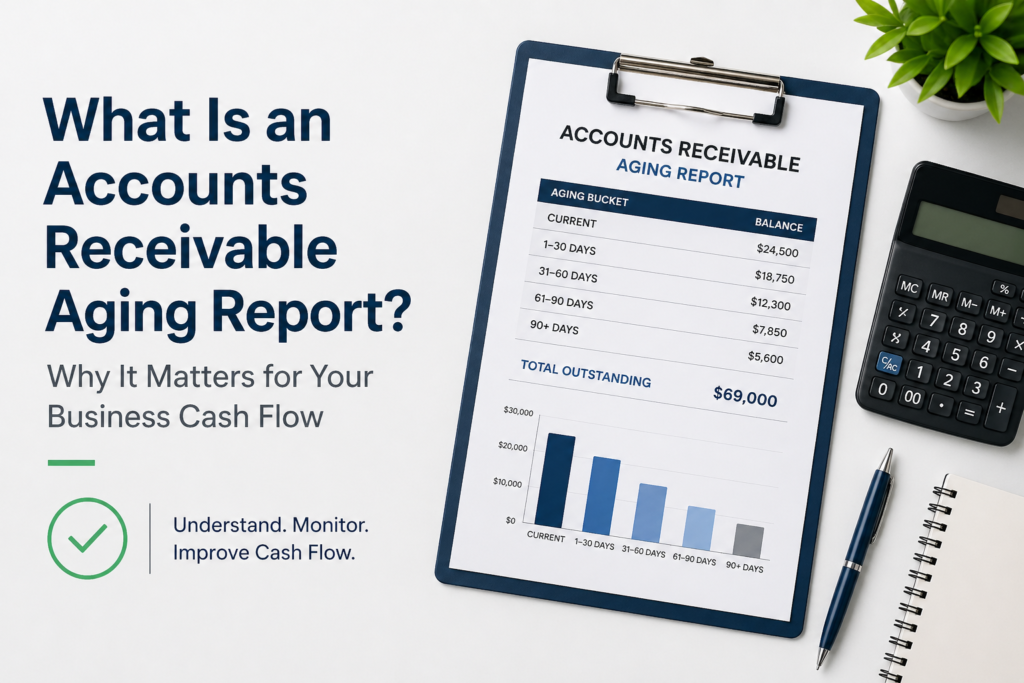
What if one simple report could warn you about cash flow problems before they happen? Your Accounts Receivable Aging Report does exactly that. It shows you which customers owe you money, how long they’ve owed it, and whether your cash flow is healthy or quietly heading for trouble.
Collecting payment from your customers on time is one of the most important parts of running a successful business. After all the hard work you’ve put into delivering your products or services, you deserve to be paid promptly.
Strong sales don’t always mean strong cash flow. In fact, many profitable businesses struggle simply because too much of their money is tied up in unpaid invoices. Without sufficient cash coming in, even a thriving company can find itself under financial pressure.
That’s why effective accounts receivable management is essential.
The Foundations of Strong Accounts Receivable Management
Businesses that consistently maintain healthy cash flow tend to focus on four key areas:
1. Timely Billing
Invoices should be sent as soon as possible after work is completed. Every day you wait is another day before payment can arrive. Delayed billing slows down your cash flow and creates unnecessary uncertainty.
Having efficient invoicing systems in place helps ensure you get paid faster.
2. Accurate Invoicing
Invoice errors can lead to costly payment delays. Common mistakes include:
- Incorrect or duplicate invoice numbers
- Wrong quantities or rates
- Billing the wrong product or service
- Incorrect customer information
Using accounting software instead of manual spreadsheets significantly reduces errors. For larger invoices, having a review process before sending can prevent costly mistakes.
3. Correct Payment Terms
Different customers may have different payment terms. Setting the wrong due date can distort your financial reports and lead to poor decision-making.
Accurate payment terms ensure your Accounts Receivable Aging Report reflects reality.
4. Timely Collections
Late payments happen. The key is addressing them quickly.
A simple reminder is often enough to prompt payment. Maintaining detailed collection notes and ensuring invoices are properly documented can make follow-up much easier if issues arise.
What Is an Accounts Receivable Aging Report?
Your Accounts Receivable Aging Report provides a detailed breakdown of all outstanding customer balances.
It organizes unpaid invoices into aging categories, typically:
- Current
- 1–30 days overdue
- 31–60 days overdue
- 61–90 days overdue
- Over 90 days overdue
This allows you to quickly identify which customers are paying on time and which accounts require immediate attention.
Why Is the Aging Report So Important?
The older an invoice becomes, the less likely you are to collect it.
As time passes:
- Customers may dispute charges
- Supporting documentation can become harder to locate
- Key details may be forgotten
- Financial difficulties may arise for the customer
- In some cases, clients’ businesses may close entirely
An aging report helps you spot these risks early, before unpaid invoices become bad debts.
What Your Aging Report Can Reveal
A well-maintained aging report can help you answer important questions:
- Are customers paying according to agreed terms?
- Which accounts need immediate follow-up?
- Is your collection process effective?
- Are certain clients becoming credit risks?
- Is your cash flow likely to tighten soon?
These insights allow you to act proactively rather than reactively.
Best Practices for Monitoring Your Aging Report
Review your aging report at least weekly, especially if your business extends credit regularly.
Pay close attention to:
- Accounts over 30 days overdue
- Customers with recurring late payments
- Large outstanding balances
- Sudden changes in payment patterns
Early action almost always leads to better collection outcomes.
Final Thoughts
Your Accounts Receivable Aging Report is far more than just a list of unpaid invoices. It’s one of the most valuable cash flow management tools your business has.
By actively monitoring it, you can improve collections, reduce bad debt, and ensure your business has the cash it needs to operate and grow.
Ready to Improve Your Cash Flow?
Accurate accounts receivable reporting is crucial for maximizing your cash flow and protecting your business.
Book a free consultation today to receive a professional review of your company’s financials and personalized recommendations to strengthen your cash flow management.